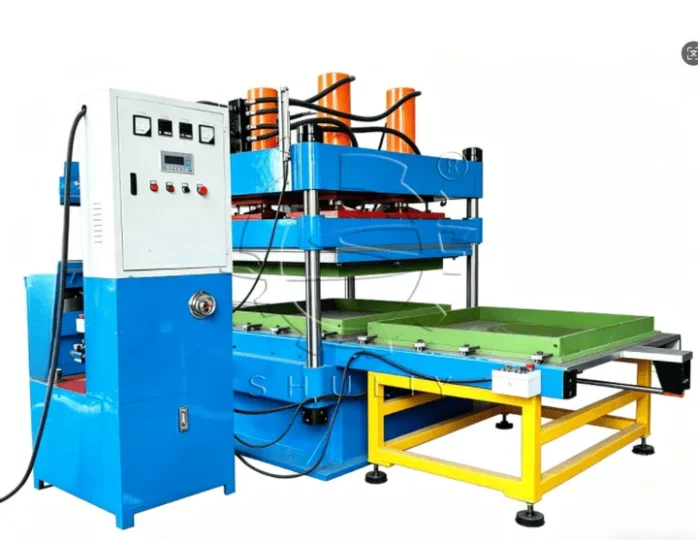
The rubber tile making machine helps manufacturers turn rubber granules into finished flooring products in different sizes, thicknesses, and shapes. Whether you plan to produce gym flooring, playground tiles, or outdoor rubber pavers, the right machine configuration depends on the products you want to make.
At Shuliy, we help customers match the hydraulic press, heating plate, and mold to their production requirements rather than choosing equipment based on machine size alone.
Start with the Rubber Tiles You Want to Produce
Before selecting a rubber floor tiles making machine, consider the specifications of your finished products.
- Tile dimensions: Standard 500 × 500 mm tiles or larger 1 × 1 m tiles.
- Tile thickness: Common options include 15, 20, 25, and 30 mm.
- Tile shape: Square tiles, rectangular tiles, interlocking designs, or custom-shaped rubber products.
- Surface color: Single-color or multicolor designs using colored rubber granules.
- Production requirements: The number of tiles required per batch and your expected daily output.
These details help determine the suitable press model and mold design.
One Machine, Different Mold Options
The mold is an important part of a rubber tile making machine because it determines the shape and dimensions of the finished product.
With a suitable mold configuration, the machine can produce different types of rubber flooring products. Our available mold options can accommodate tile thicknesses of 15, 20, 25, and 30 mm.
The mold surface features a non-stick Teflon coating, which helps with demolding and reduces the need to apply release agent during each production cycle.
For customers who want to expand their product range, custom molds can also be considered according to the required tile design.
What Determines the Machine’s Production Capacity?
The output of a rubber tile press is not determined by hydraulic pressure alone. Several factors work together.
- Mold capacity: The number of tiles that can be formed in one pressing cycle.
- Heating and curing time: The rubber mixture needs sufficient time under the required temperature and pressure.
- Tile thickness and dimensions: Different product specifications may require different processing times.
- Loading and demolding: The time required to fill the mold and remove finished tiles affects the overall cycle.
For this reason, we recommend confirming the tile size, thickness, and mold layout before estimating production capacity.
Rubber Tile Making Machine Models and Specifications
We offer different press configurations for different rubber tile production requirements.
| Especificação | D550 × 550 | D1100 × 1100 |
| Nominal pressure | 50 tons | 120 tons |
| Heating plate size | 550 × 550 × 45 mm | 1100 × 1100 × 50 mm |
| Mold layers | 4 layers | 1–2 layers |
| Potência do motor | 3 kW | 4 kW |
| Typical tile size | 500 × 500 mm | 500 × 500 mm or 1 × 1 m |
The D550 × 550 model is suitable for customers considering a compact press with a multilayer mold arrangement. The D1100 × 1100 model offers a larger heating plate for different mold layouts and larger tile formats.
The final configuration should be confirmed according to your product specifications and production plan.
What Raw Materials Do You Need?
Rubber flooring production commonly uses rubber granules mixed with a binder and, when required, pigments.
A typical formulation may include:
- Base layer: Black rubber granules, commonly around 1–4 mm.
- Surface layer: Finer colored rubber granules, commonly around 0.6–1 mm.
- Binder: Helps bind the granules together during molding.
- Pigment: Used when a particular surface color is required.
The exact material sizes and formulation depend on the tile design and the required surface finish.
If you plan to process waste tires yourself, a rubber powder or granule production system can be used to prepare the raw material before tile molding. This allows you to connect rubber recycling with finished flooring production.
From Rubber Granules to Finished Flooring
A typical production process includes the following steps:
- Prepare the materials: Screen the rubber granules and prepare the binder and pigments.
- Mix the ingredients: Blend the materials evenly according to the product formulation.
- Fill the mold: Place the mixture into the mold, arranging the surface and base layers if the design requires them.
- Press and heat: The hydraulic press applies pressure while the heating system supports the curing process.
- Demold and cool: Remove the formed tiles and allow them to cool.
- Inspect the products: Check dimensions, thickness, appearance, and surface quality.
Actual processing time depends on the material formulation, tile thickness, mold, and operating conditions.
If Your Raw Material Is Waste Tires
If your raw materials are still whole waste tires, we can provide a complete waste tire recycling line to process them into rubber powder or rubber granules for tile production. The equipment configuration can be adjusted according to your tire sizes, processing capacity, and final material requirements.
We can also customize the output particle size to suit your rubber tile manufacturing needs. With our integrated solution, you can process waste tires into suitable rubber materials and then use them to produce rubber flooring tiles.
Where Can You Use the Finished Rubber Tiles?
Rubber tiles are used in a variety of flooring applications, including:
- Gyms and fitness centers
- Children’s playgrounds
- Sports and recreational areas
- Outdoor walkways
- Commercial and residential flooring
- Agricultural and other specialized facilities
Different applications may require different thicknesses, surface textures, and tile shapes. Confirming the end use early helps you choose the right mold and rubber tile making machine configuration.
Let’s Configure a Rubber Tile Making Machine for Your Project
Are you planning to produce standard rubber floor tiles or custom-shaped products? We can help you evaluate the appropriate rubber tile making machine model, mold arrangement, heating plate size, and supporting equipment.
To receive a suitable recommendation, tell us:
- Your required tile dimensions and thickness
- The shape and surface color of the tiles
- Your target production capacity
- Whether your rubber granules are purchased or produced in-house
With this information, we can recommend a rubber tile making machine configuration that better matches your actual production needs.